Your dog doesn't lose it because he's aggressive. He loses it because he never came down from yesterday.
A 14-day protocol for dogs that go off on the lead, built on what the research actually shows about stress recovery. No prong collar, no e-collar, no hour-long session with a trainer.
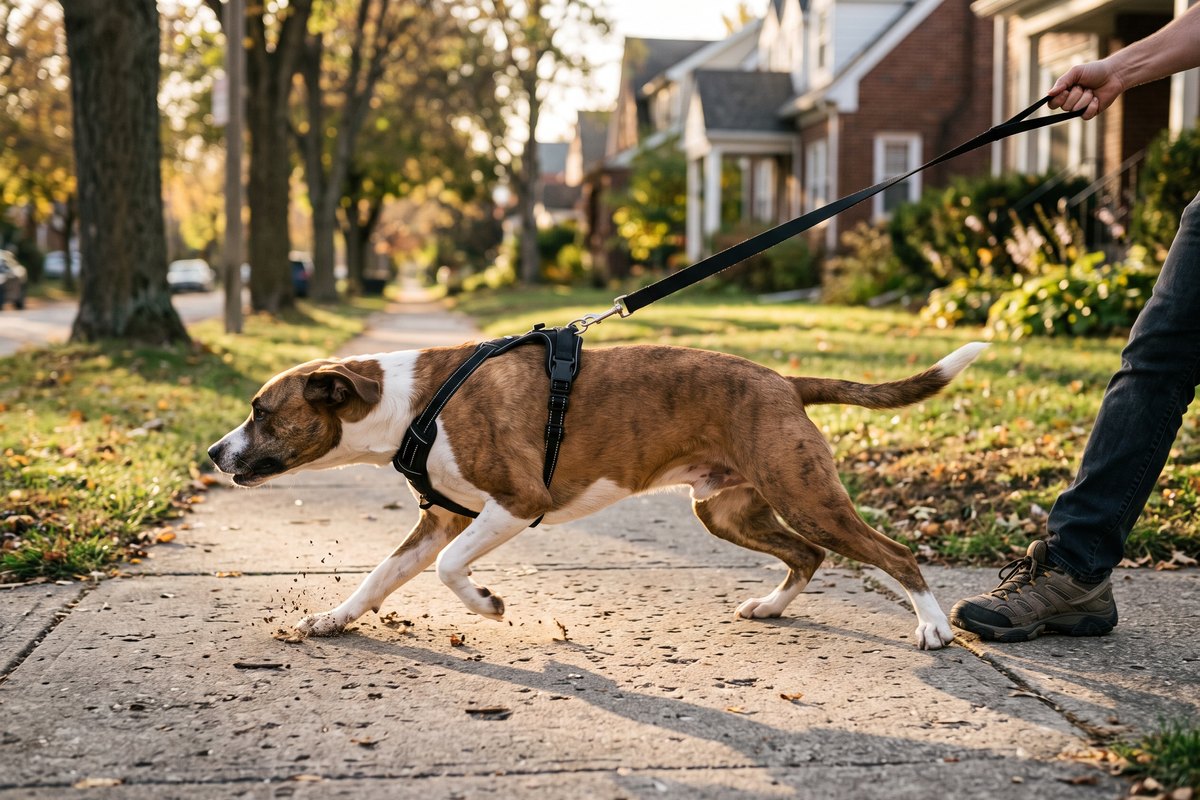
You know the routine off by heart.
You head out at six because there are fewer people about. You walk the odd-numbered side, the one you can cross from quickly. Your arm is half-braced, lead wrapped twice around your hand, scanning the corner before you turn it like you're sweeping for mines. Then a dog appears thirty metres out and that's it: yours goes up, plants all four paws, and lets out that hoarse barking that doesn't even sound like the dog asleep on your bed.
You drag him across the road with your heart in your ears while the other owner just stands there giving you that look. Sometimes there's a comment with it. "That one should be muzzled." You apologise. Again.
You get home with the lead printed into your palm, sit down still wearing your shoes, and do the sum you do every week: how long has it been since walking my own dog stopped being the best part of my day?
Then there's the part nobody says out loud.
You've started going later, almost at night, when the street is empty. You've turned down going to someone's place because there was nobody to leave him with. You've stopped using the park you both loved. And one bad night, wrung out, you thought for three seconds about rehoming him, and spent the rest of the week ashamed you'd thought it.
You don't have an aggressive dog. You have a dog who is stuck inside a state he can't get out of, and you're stuck in there with him.
Because there is something genuinely odd about this, and it's the thing that changes everything.
Indoors he's a different animal. Sits when you ask. Drops the toy. Lies down with his head on your foot and sighs. You've trained with treats in the living room and it worked beautifully. You took the exact same treats to the street and he wouldn't even turn his head towards your hand.
If it were aggression, he'd be aggressive at home too. He isn't.
What showed up when researchers stopped watching the explosion
In 2019 a group published a study in PLOS One that did something simple and uncommon. Instead of only measuring how hard a dog reacted to a fright, they measured his cortisol three times: before the trigger, ten minutes after, and forty minutes after.
The expectation was that the problem dogs would be the ones reacting hardest at the peak. That is not what turned up.
A strong reaction at ten minutes came out linked to desirable traits. Switched-on dogs, tuned into their environment, quick. What came out linked to fearfulness and to rivalry with other dogs was the forty-minute reading. The problem dogs were the ones still elevated long after the fright was over.
It isn't the peak. It's the climb down.
Which is why he gets worse as the week goes on
There's a name for this in the behaviour literature, and the American Kennel Club publishes on it. It's called trigger stacking. Several frights in a short window add together, and the dog starts reacting out of all proportion to something small. The AKC's own piece is honest enough to say there's no fixed timeline: some dogs come down fast, others carry it for days.
It's the debt he never managed to pay. And it falls due every evening at six.
There's a third piece, and it's the one that tends to catch in your throat.
Also in 2019, Scientific Reports published a study of 58 dog-and-owner pairs, measuring accumulated cortisol in the dogs' hair and the owners' hair. The two levels came out strongly correlated. Then the researchers went after the direction of it, and the result ran one way only: the owner's personality traits explained the dog's cortisol, and the dog's own traits did not.
The dog mirrors the owner. Not the other way round.
Hair cortisol was measured in both dogs and owners across two seasons of the year, so it reflects months of accumulated stress rather than one bad afternoon. The correlation held in both measurements.
When the researchers tested which way the influence ran, the owner's traits predicted the dog's cortisol and the dog's traits predicted nothing.
Before you read that as an accusation, read the next sentence slowly, because it's why the study is on this page at all: this does not mean you caused the problem. It means there is a lever in your hand that nobody told you existed.
If your tension counts towards his, then so does your calm. And your calm is the one variable in this whole story that is under your control, every day, for free, without depending on a trainer, on kit, or on the goodwill of the neighbour.
Why everything you've tried couldn't have worked
Look at the list of things you've already done. Only now look at it through the climb down instead of the explosion.
Works at home and fails on the walk because above threshold a dog's brain doesn't process reward. The method was right. The moment you applied it wasn't.
A run, the ball, an hour at the park. Hard exercise also raises arousal, so instead of paying the debt down you added to it and left the house starting from even higher.
An hour covers the explosion and leaves before the climb down, which is exactly where your problem lives. The professional saw the dog who reacts. He never saw the dog who doesn't come down.
It erases the warning and keeps the debt. You didn't get a calm dog, you got a dog who detonates without signalling first, which is far worse to manage.
Not one of those four is stupidity on your part. All four are what the entire internet recommends. All four are aimed at the wrong moment in the process.
What The Leash Truce is
A 14-day protocol in three blocks, and each block exists to solve a specific part of what you've just read. You do it at home and in the street, with the lead you already own, in fifteen to twenty-five minutes a day.
Clear the debt
Decompression. For four days you train nothing and expose him to no triggers at all. It sounds backwards and it's the block that surprises people most, because it's where most owners see the first change without having taught a single command.
Work under the line
Now exposure, measured by distance and always below his threshold. This is where the positive reinforcement you already knew comes back, this time at the point in the process where your dog's brain can actually take the information in.
Train the climb down
The part nobody teaches. Exercises that shorten how long he takes to return to normal after a fright. It's what stops the debt starting over again next week.
What you get
Day by day, from one to fourteen, as a PDF you can read on your phone during the walk itself.
The body signals your dog gives in the seconds before he goes off. Once you can read them, you never stop being able to.
One page a day to time how long he took to come back to normal. It's what turns "I think it's better" into a number.
Where and when to walk in the first ten days, so you don't sabotage your own protocol without noticing.
For the day it all goes wrong. That day comes, and having written instructions for it is the difference between a stumble and giving up.
One day of the protocol, as it looks on your phone.
Why not just book a trainer
That's the right question to ask, and I'm not going to pretend the answer is always me. It depends what you're buying.
| In-person trainer | Generic obedience course | The Leash Truce | |
|---|---|---|---|
| Cost | Well over a hundred a session, and rarely one session | Roughly the same range as this | A$47, once |
| What it targets | The behaviour, in the moment it happens | General obedience: sit, stay, heel | Recovery time after the trigger |
| Blind spot | The session ends before the climb down, which is where the problem lives | Teaches commands above threshold, where the dog can't learn | It isn't personalised. It's a protocol, and you adapt it by distance |
| When it's the right call | A bite that broke skin, or you want someone beside you in the street | A dog with no behaviour problem, just no basic manners | A dog who has been trained and still goes off on the lead |
Look at the blind spot row, because that's where the decision sits. I'm not saying trainers don't work. I'm saying an hour of session covers the explosion and leaves before the climb down, and that an obedience course teaches commands at the exact moment your dog's brain can't take a command in. Good tools, pointed at the wrong target.
And I'll be straight about my own limitation too: this is not one-to-one coaching. It's a protocol, written once, that you adapt to your dog by adjusting the working distance. If what you want is somebody looking at your case every day, an in-person professional is worth the money. If what you want is to understand why nothing has worked so far and to have a path you can walk on your own, this is it.
Who it's for, and who it isn't
It's for you if
- Your dog is an adult and reacts on the lead to other dogs, people, bikes or motorbikes
- He listens indoors and becomes a different animal outside
- You've already tried treats, tiring him out, or a session with a trainer
- You've changed your walking times or routes to avoid running into anyone
- You'll commit fifteen to twenty-five minutes a day for a fortnight
It isn't for you if
- Your dog has bitten a person or another dog and broken skin. See a professional in person
- The issue is a puppy toileting indoors. Different subject entirely
- You want someone following your individual case day by day
- You're after new tricks and commands. There are none here
- You don't intend to apply any of it and just want to read about the topic
Something I need to tell you before you decide
This material is being finished now and this is the first cohort. That has a bad side and a good side, and you deserve both.
The bad side is that I don't have a wall of testimonials to show you yet. I'm not going to invent any, which is why you haven't seen a single one on this page. What I have to offer instead is the mechanism, with the three studies cited and linked at the bottom, so you can check it yourself before spending a cent.
The good side is the first-cohort price, and the 30-day guarantee below, which exists precisely because the risk of buying without social proof is mine and not yours.